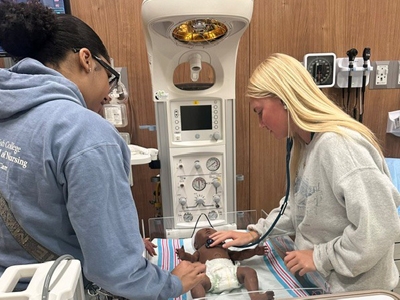
The simulation lab at Barnes-Jewish College Goldfarb School of Nursing is a state-of-the-art, immersive clinical practicum to help students bridge the gap between coursework and clinicals. The use of cutting-edge technology and hypothetical nursing scenarios prepares students to transition to work beyond the classroom and into hospital and clinical settings.
And now, the simulation lab is using these valuable assets to encourage high school and middle school students to consider a career in health care. This spring and summer, it hosted several groups of younger students involved in science and health care programs. Shawne Manies, PhD, RN, Goldfarb director of simulation, says she aims to have these experiences be intentional and meaningful based on each class or organization’s goals, education level, and prior health care exposure. But the overarching objective is the same for everyone.
“We want every student leaving our center feeling empowered and realizing that they are capable of helping save lives,” she says.
Solving problems through nursing teamwork
One group that participated in June was Bridges to Medicine, an organization passionate about helping students explore how science, technology, engineering, and math are used in real health care settings. The students spent the day at Goldfarb, visiting different stages and applying STEM to real-life situations in nursing.
In the simulation lab, they played a game called “Nurse Detective.” The students entered a room with multiple safety concerns, such as unplugged equipment, an out-of-reach call light, and misplaced oxygen tubing. The students were challenged to identify the issues and to prioritize which ones to address first.
“Partnering with Goldfarb School of Nursing provides a meaningful opportunity to expand access to health care career exploration for young students,” says Madeline Awad, program coordinator of Bridges to Medicine, who coordinated the event. “Including nursing in the program is especially important because nurses play such a vital role in patient care and the health care system as a whole. Early exposure to these careers helps inspire the next generation of health care leaders and contributes to building a workforce that better reflects the communities it serves.”
PRIME opportunities to learn
Another group to visit was PRIME, a high school program developed through WashU Medicine. Ten students from the Ferguson-Florissant School District were selected for the summer internship program. The students spent part of the day at a health care facility and then going out to work in the Integrated Health Network, a health equity nonprofit made up of all three major hospital systems and other public health organizations. At Goldfarb, they learned about CPR compressions, how to take vital signs, and how to stop bleeding.
The simulation lab also hosted students who are already on the path to a career in health care. In May, Lindbergh High School’s Diploma Plus track worked through patient care scenarios and spoke with Goldfarb student ambassadors. This program allows students to take the Missouri certified nurse assistant exam after graduating with their high school diploma. It was created to address a shortage of health care workers in the St. Louis region and to prepare students for job readiness as they enter the workforce.
Students toured Goldfarb’s state-of-the-art facilities, interacted with Goldfarb student ambassadors, and worked on community life-saving skills. The students also ran through patient care scenarios using high-fidelity manikins and other health care technology tools, while focusing on the importance of teamwork and communication.
Shawne says the Clinical Simulation Institute looks forward to growing similar partnerships with other local school districts. To learn more about the Clinical Simulation Institute, visit the Goldfarb website.